A driveway can look uneven long before the main surface has worn out. Loose block edges, gravel spilling into borders and crumbling tarmac sides all make an otherwise good entrance look poorly finished. Choosing the best driveway edging materials helps keep the surface contained, protects the base beneath it and gives the whole property a cleaner, more durable finish.
For homes across Central Scotland, edging needs to cope with regular rain, frost, vehicle weight and day-to-day use. The right choice depends on the driveway surface, the look you want, the condition of the ground and how much maintenance you are willing to take on.
Why driveway edging is worth getting right
Driveway edging is not simply a decorative border. It creates a firm restraint around paving blocks, gravel or tarmac, stopping the surface from spreading outwards under the weight of cars. Without proper edge restraints, block paving can begin to separate, gravel migrates onto paths and roads, and the edge of a tarmac drive can crack away.
It also provides a clear line between the driveway and lawn, planting beds, paths or walls. That makes mowing easier, reduces damage to soft landscaping and gives a new driveway a more considered appearance.
The important part is what sits below the edging. Even high-quality kerbs can move if they are installed on weak or uneven foundations. A correctly prepared sub-base and concrete bedding are usually more important to long-term performance than choosing the most expensive finish.
Best driveway edging materials to consider
Concrete kerbs: practical and dependable
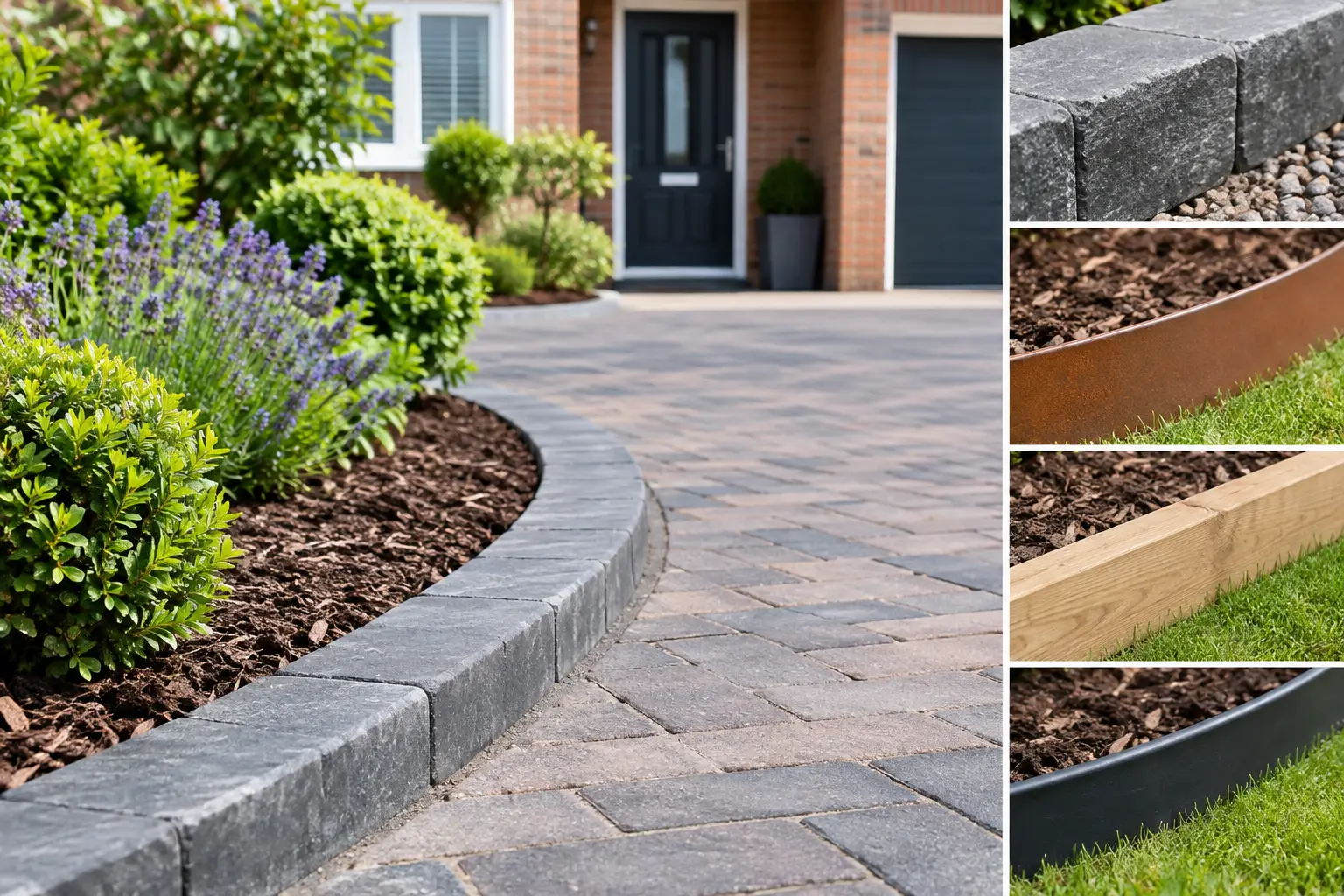
Precast concrete kerbs are one of the most common choices for domestic driveways, and for good reason. They are strong, widely available and suitable for block paving, gravel and tarmac. They can create straight runs, gentle curves and clearly defined entrances without pushing the budget too far.
Standard grey concrete is the most economical option, while coloured or textured kerbs can be chosen to complement paving or property brickwork. Concrete can look plain beside premium materials, but it is a sensible choice where strength, affordability and a neat result matter most.
For driveways that take regular vehicle use, concrete kerbs need to be properly haunched with concrete at the back. This support prevents movement when tyres pass close to the edge.
Block paving edging: a coordinated finish
Using contrasting block pavers around the perimeter is a popular option for monoblock driveways. A charcoal border around brindle or natural-coloured blocks, for example, frames the driveway and gives it a more finished appearance. It is especially effective on driveways where the border is visible from the road or runs alongside a path.
Block edging offers plenty of choice in colour, size and laying pattern. However, it is only as secure as the installation beneath it. Individual blocks must be laid on a solid concrete edge restraint rather than simply placed into sand, or they can shift over time.
This option tends to cost more than basic concrete kerbs because of the extra materials and labour, but it is often worthwhile where appearance is a priority. It also makes future repairs easier, as damaged individual blocks can be lifted and replaced.
Granite setts: premium and hard-wearing
Granite setts, sometimes called cobbles, provide one of the most durable and attractive edging options. Their natural texture and variation suit traditional properties, stone-built homes and driveways designed to feel more substantial. Granite also works particularly well as a strong border between tarmac and paving.
The main advantage is longevity. Properly installed granite is highly resistant to weathering, vehicle traffic and frost. It will not fade in the way some coloured concrete products can, and it develops character rather than simply looking worn.
The trade-off is cost. Granite materials and fitting are usually more expensive, particularly where curved edges, detailed cutting or extensive groundwork are required. It is a good investment for a feature driveway, but may be unnecessary for a simple functional parking area.
Natural stone kerbs: traditional character
Sandstone, limestone and other natural stone kerbs can bring warmth to a driveway and tie it in with existing garden walls, paving or the style of an older property. Their softer, more natural appearance makes them a good fit beside landscaped gardens.
Not all stone performs in the same way. Some types are more porous and may show staining or weather marks more readily, while others can be prone to chipping if struck. A suitable stone should be selected for vehicle areas, and the edging should be sealed only where the product and finish require it.
Natural stone generally needs more careful sourcing and installation than concrete. It is best chosen for projects where visual continuity with the rest of the garden is as important as the driveway itself.
Steel edging: clean lines for lighter-use areas
Steel edging creates crisp, narrow lines and is often used around contemporary gravel drives, planting areas and paths. Galvanised steel offers a simple industrial look, while corten steel develops a rust-coloured finish that can work well in modern garden designs.
It is not normally the first choice for a driveway edge that will be repeatedly mounted by vehicles. Thin metal edging can bend if tyres run over it, and it does not provide the same structural restraint as a concrete-backed kerb. It is better suited to defining gravel borders or separating lawn from a driveway where the vehicle route is clearly set back.
If choosing steel, allow for a strong fixing system and avoid using it as the sole support for block paving. Its strength is in appearance and neat separation, not heavy-duty containment.
Timber edging: affordable but limited
Pressure-treated timber sleepers or boards can be used to define a gravel driveway, particularly in rustic or informal gardens. Timber is easy to cut, can be installed at different heights and may suit a property with fencing, decking or raised beds nearby.
Its limitation is lifespan. Timber in contact with damp ground will eventually deteriorate, even when treated. It can also move, split or become uneven after repeated wet and cold conditions. For a temporary solution or a lightly used gravel parking area, it can be cost-effective. For a main driveway expected to last for many years, concrete or stone is usually the safer option.
Match the edging to your driveway surface
The best edging material is usually the one that supports the surface correctly. Block paving needs firm edge restraints because the blocks rely on the perimeter to hold their shape. Concrete kerbs, block borders on concrete bedding and granite setts are all reliable choices.
Gravel driveways need a physical barrier high enough to stop stones escaping, but not so high that it creates a trip hazard or makes access awkward. Concrete edging, granite setts and low kerbs work well. Steel can work on lightly used edges, provided it is not in the tyre path.
Tarmac needs support along its sides to prevent the material from breaking down at the edge. Concrete or granite kerbs are particularly suitable, as they give the tarmac a firm finished boundary. A well-installed kerb line also makes later resurfacing or patching much cleaner.
Resin-bound driveways are often finished with block paving, aluminium or stone borders. The edging should be installed first and set at the correct level, allowing the resin surface to be laid neatly within it.
Think about drainage before choosing a border
A driveway edge should never trap water where it can sit against the house, soften the sub-base or run onto a neighbouring property. This is especially relevant in areas that see frequent rainfall. The driveway should be designed with suitable falls, and drainage channels or permeable construction may be needed depending on the layout.
Solid kerbs are excellent at holding a surface in place, but they do not let water pass through. Where drainage needs to cross the driveway edge, the design may need gullies, channels or carefully positioned outlets. This is a groundwork issue that should be planned before the edging is installed, not corrected afterwards.
Installation matters as much as material
A driveway border that is level, tightly aligned and securely bedded makes the entire job look professional. More importantly, it prevents costly movement later. The ground should be excavated to the correct depth, the sub-base compacted properly and the edging set to line and level on a suitable concrete bed.
Corners, curves and dropped sections at entrances deserve particular care. These are the places most likely to receive tyre pressure, so they need enough support behind them. If the driveway is replacing an old surface, checking for soft ground, poor drainage and damaged existing foundations before work starts can avoid repeat problems.
North Lanarkshire Garden Care can assess the full driveway area, including excavation, drainage, edging and the finished surface, so the work is planned as one job rather than a collection of separate fixes.
A good driveway edge should look simple once it is finished. Choose a material that suits the property, but make sure the preparation underneath is built to handle the weather and traffic it will face for years to come.